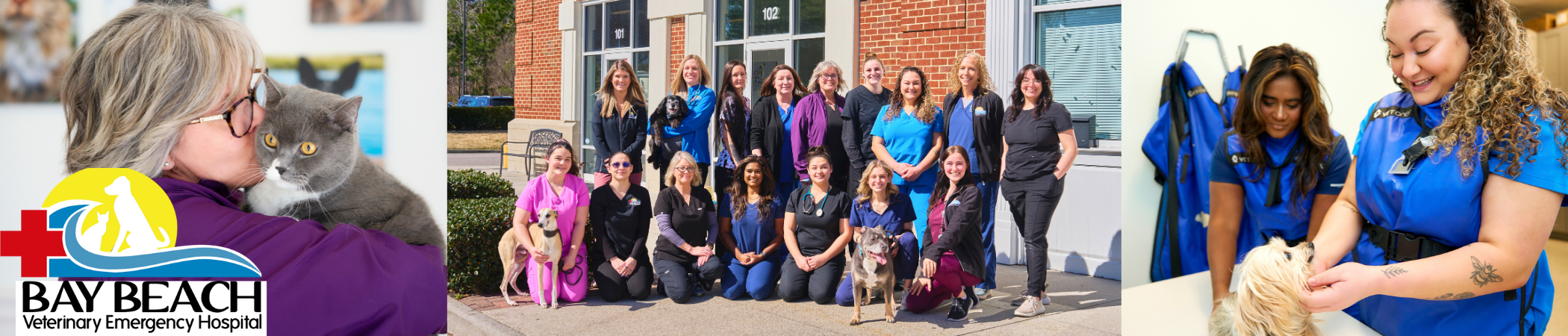
Bay Beach Veterinary Emergency Hospital - Veterinary Assistant
Bay Beach Veterinary Emergency Hospital in Virginia Beach, Virginia is a multi-doctor 24/7 emergency practice serving 90% companion animals and 10% exotics. We have a strong focus on maintaining exceptional client communication, patient care and medical protocol standards, and visiting specialists provide echocardiogram and advanced ultrasound service. We believe every patient and client deserves the best medicine and care we can offer. Bay Beach Veterinary Emergency Hospital also has a General Practice sister hospital (6 doctors, fully staffed) located just 20 minutes away, in the heart of Virginia Beach.
Veterinary Assistant (Emergency)
Reporting Structure: The veterinary assistant works under the direct supervision of the shift LVTs, shift DVMS, emergency services supervisor, veterinary practice manager, or medical director; who will indicate general assignments, limitations and priorities. Recurring assignments are performed independently. Deviations or unfamiliar situations are referred to the shift leader or supervisor. Completed work is reviewed for technical accuracy and compliance with established procedures.
Veterinary Assistant Objectives: The purpose of this position is to serve as a veterinary assistant for Bay Beach Veterinary Hospital's Emergency Service, to perform hands on duties related to patient care and treatment, and to provide miscellaneous support to the veterinary practice manager and health care team. These service functions include but are not limited to, care of hospitalized patients, triage of incoming patients, review of estimates and treatment plans, loading exam rooms, communicating with clients, notating, and invoicing treatments and supplies, set up for procedures and surgeries, assisting with blood draws, radiographs and other diagnostic procedures, general cleanliness and stocking of the hospital. This job requires a practical knowledge of hospital organization and services, the basic rules and regulations governing visitors and animal patient treatment, and a practical knowledge of the standard procedures, veterinary records and terminology used in the hospital. Regular attendance and timeliness are an essential function to fulfill the requirements of this position.
Position type and expected hours of work:
-
Full or Part-Time
-
8 to 12 hour shifts variable days of the week
-
Weekend shifts required
-
Overtime may be required
Education and Experience:
-
High school diploma or equivalent
-
Veterinary experience required
General Knowledge:
-
Possession of strong organizational skills.
-
Ability to multitask.
-
Knowledge of the range of services the practice provides and the species it treats.
-
Knowledge of practice polices regarding provision of care, treatment of stray animals, deposits for hospitalized patients, payments, and credit/payment options.
-
Knowledge of and compliance with OSHA standards and be able to find Material Safety Data Sheets quickly.
-
Possession of strong organizational skills.
-
Ability to multitask.
-
Knowledge of the range of services the practice provides and the species it treats.
-
Knowledge of practice polices regarding provision of care, treatment of stray animals, deposits for hospitalized patients, payments, and credit/payment options.
-
Knowledge of and compliance with OSHA standards and be able to find Material Safety Data Sheets quickly.
-
Reasonable familiarity with zoonotic (transmissible from animals to humans) diseases, including their prevention and steps to reduce or eliminate transmission.
-
Reasonable familiarity with common animal to animal contagious diseases, including their prevention and steps to reduce or eliminate transmission.
-
Understand the life cycle and pathology of common internal and external parasites, including common treatments and prevention.
-
Performs other duties as assigned.
Communication Skills:
-
Excellent verbal and written communication skills.
-
Excellent interpersonal communication skills.
-
Ability to communicate with clients in a compassionate and professional manner in times of stress.
-
Accurately obtain and then relay the owner's account of the medical problem/injury to the doctor and other health care team members.
-
Possess active listening skills, giving full attention to what other people are saying, taking time to understand the points being made, asking questions as appropriate and not interrupting at inappropriate times.
-
Knowledge of the structure and content of the English language including the meaning and spelling of words, rules of composition, and grammar.
-
Competently speak and write the English language.
-
Understanding the implications of new information for both current and future problem-solving and decision-making.
-
Requires writing complete notes in medical records.
General Tasks:
-
Always be in position and prepared to work by the start of each scheduled shift.
-
Maintain accurate personal timecards.
-
Maintain professional appearance while at work, including clean and pressed uniforms, neat hair, and proper personal hygiene.
-
Have the physical strength and ability to stand for an entire shift when needed and be able to lift pets and objects weighing up to 40 pounds without assistance. Assist in lifting patients and objects weighing more than 40 pounds.
-
Ensure the cleanliness and organization of the hospital, including but not limited to: treatment area, kennels, procedure rooms, exam rooms, parking lot and grounds.
-
Clean and maintain all hospital equipment according to manufacturer's instructions and hospital policy.
-
Maintain an even, friendly demeanor while on the job.
-
Promote a positive attitude among staff.
-
Handle stress with poise and tact.
-
Show respect for clients, patients (alive or deceased), team members, and the hospital always. Be willing and available to stay late or work through breaks, when needed to assist with emergency or critical-care patients.
-
Engage in productive work during slow periods.
-
Ensure daily/weekly/monthly task lists are completed.
-
Readily assist coworkers as needed.
-
Stock hospital supplies, pharmaceuticals and pet-food as needed and facilitate depleted items being placed on the order list.
-
Regularly check for outdated stock. Remove and replace expired items as directed. Participate in all staff training and meetings.
-
Always be cognizant of patient safety.
-
Understand and maintain strict client confidentiality.
-
Be prepared to handle any pet or facility emergency that may arise. Know and follow contingency plans.
Clerical Tasks:
-
Access client information within the practice management software system. Enter and retrieve client and patient data in the computer.
-
Accurately notate details about patients, their care and client conversations in the medical record including vitals and treatment details.
-
Check in and input patients and clients into computer. (overnight)
-
Collect, post, and record client fees and deposits, make change, process credit card transactions, and assist in making count of cash drawer. (overnight)
-
Assist in the ordering, receiving, stocking and distribution of supplies.
-
Know phone functions including hold, intercom, and transfer.
-
Accurately enter items and services into invoices as needed.
-
Assist clients in filling out/completing electronic forms.
-
Save hard copies of paperwork into client files.
Customer and Personal Service Tasks:
-
Provide friendly and quality care to the clients and patients of Bay Beach Veterinary Hospital
-
Receive incoming phone calls, screen those that are handled by other health care team members and take care of all other calls, both urgent and routine. Provide knowledgeable sub-professional advice concerning the care and treatment of animals. (overnight)
-
Check clients in and greet clients in a professional, friendly, and hospitable manner. (overnight)
-
Communicate effectively, compassionately, and professionally with clients during the triage process.
-
Handle angry or grieving clients in a calm and reassuring manner. Enlist the help of a doctor or supervisor when needed.
-
Assist clients to their cars if needed.
-
Verify or witness clients' statements regarding procedures, including euthanasia.
-
Answer questions and educate clients about basic pet care and procedures. Refer questions you cannot answer to appropriate colleague.
Triage Tasks:
-
All patients triaged within 15 minutes of arrival in hospital.
-
Obtain brief history from owner.
-
Obtain full TPR and bring any abnormalities to the attentions of the DVM/LVT.
-
Assign patient to proper triage class based on BBVH color system.
-
Ensure patients are placed in appropriate place to wait to be seen based on presenting complaint and condition (isolation, ICU, with owner, etc.).
Exam Room Tasks:
-
Always ensure cleanliness of exam rooms.
-
Bring owners into the exam room.
-
Explain treatment plans and estimates to the owners and answer questions. Refer questions you cannot answer to appropriate colleagues.
-
Explain financial policies including payment options and how to apply for them.
-
Liaise between the DVM and owner when appropriate.
-
Thoroughly explain discharge instructions and medications to owners and answer questions. Refer questions you cannot answer to the appropriate colleagues.
-
Fill non-controlled veterinary prescriptions with appropriate medication, provide routine instructions to owners concerning prescriptions for medications.
Patient Care Tasks:
-
Possess sufficient strength and assertiveness to effectively restrain patients and ensure their safety and that of clients and personnel.
-
Restrain patients in a manner that allows necessary work to be performed, minimizes stress to patients and ensures the safety of patients and people. Safely and effectively apply and use restraints such as muzzles, towels, and gloves. Apply low stress handling techniques.
-
Maximize patient's comfort with a gentle reassuring manner. Understand that actions that would constitute animal cruelty under state or local law or hospital policy will be grounds for immediate disciplinary action, up to and including termination.
-
Monitor patient's behavior and note potentially anxious or aggressive behaviors. Use caution when handling potentially aggressive patients. Request help when needed.
-
Inform the shift supervisor and practice manager immediately of any bite or scratch wounds and follow hospital policy for seeking treatment.
-
Accurately obtain vital signs including, but not limited to: rectal temperature, respiratory rate, heart/pulse rate, mucous membrane color, capillary refill time, and blood pressure.
-
Understand the rules and application of basic standards of asepsis. Maintain IV catheters so fluids flow freely; flush and clean as needed.
-
Set up and administer fluids both IV and SC.
-
Using aseptic technique, draw up injectable medications according to DVM/LVT instructions.
-
Properly fill and store non-injectable medications for hospitalized patients.
-
Properly administer medications via oral, SC and IV {in IV catheter only) routes according to protocol and hospital policy.
-
Dispose of used needles and syringes and other sharp objects as set forth by the practice policy and OSHA standards.
-
Perform suture removals and nail trims.
-
Assist with diagnostic procedures, including but not limited to: venipuncture, radiography, corneal stain, skin scrapings and other cytology samples, and ultrasonography.
-
Obtain fecal and ear cytology samples.
-
Perform routine ELISA tests, such as heartworm, feline viral, and parvo.
-
Lay out/set up instruments that doctors will use during exams according to presenting complaint.
-
Assist with routine and non-routine treatment procedures, including but not limited to: fluid administration, medication administration {injectable, oral and topical), IV catheter placement, abdominal and thoracentesis, urinary catheter placement, and bandage/splint placement.
-
Prioritize tasks to maximize client satisfaction and patient health.
-
Place appropriate bedding in patient cages and always ensure its cleanliness, changing when soiled.
-
Monitor patients for vomit, blood, urine, and feces in cage. Clean patients and cage as needed. Save debris if unsure whether it should be examined. Note occurrences in patient record.
-
Asses hospitalized patient's vital signs and record data appropriately, alerting DVM/LVT of any changed/out of normal range results.
-
Monitor patients for changes in condition and alert DVM/LVT immediately.
-
Know and recognize signs of pain and common methods of pain relief. Alert DVM/LVT to patient's pain/comfort level.
-
Strictly follow isolation procedures and policies. Prevent contact between contagious animals and others. Properly disinfect the area and you using appropriate disinfectants and dilutions.
-
Disinfect cages as soon as possible after patients are removed from them.
-
Walk dogs individually on a leash according to directions and hospital policy and record eliminations appropriately in record.
-
Prepare meals and feed animals according to treatment plans. Note appetite in record.
-
Perform medical grooming including medicated baths, mat removal, and sanitary clips/baths.
-
Wash, dry and store bedding, and towels belonging to the hospital. Maintain bedding in good repair.
-
Assist with euthanasia procedures.
Emergency Care Tasks:
-
Know and be able to perform basic life support procedures, including CPR, airway maintenance, and oxygen administration.
-
Be up to date with the latest RECOVER CPR guidelines and procedures.
-
Control bleeding using pressure bandages and tourniquets.
-
Apply cooling techniques to heatstroke patients
-
Be ready and available to assist and follow instructions in a calm and efficient manner.
-
Know the location of the crash cart and be familiar with all its contents and their uses.
-
Know the location of and how to use essential monitoring equipment, such as SPO2, ECG, and blood pressure monitors.
-
Apply critical thinking to assess patient status.
Surgical Assisting Tasks:
-
Know the names of instruments and where they are stored.
-
Prepare the surgery suite for pending surgeries.
-
Assist LVTs in administering preoperative medications.
-
Bring patients to the pre-operative/induction area.
-
Assist with the induction process.
-
Assist with preparing the patient for surgery including positioning, clipping and prepping surgical site, and securing monitoring equipment.
-
Assist surgeons with aseptic gowning and gloving.
-
Clean surgical suite and instruments after procedure.
-
Wash and store endotracheal tubes according to hospital policy.
-
Clean and wrap instruments according to hospital policy.
-
Autoclave packs and gowns according to autoclave directions.
Radiology Tasks:
-
Always wear dosimeter badge according to provider instructions.
-
Always wear protective equipment according to OSHA and hospital policy.
-
Assist DVM/LVT/VA with positioning of patients.
-
Always follow laws and hospital policy when performing radiographs.
Supervisory Role
-
Knowledgeable of all aspects of hospital protocol, from the front desk to the treatment area.
-
Knowledgeable of all aspects of veterinary medicine, from the front desk to the treatment area.
-
Knowledgeable of all aspects of veterinary medicine as a business.
-
Able to constructively discuss and troubleshoot issues within the hospital with staff members and management.
-
Promotes and ensures training and coaching
-
Ensures maintenance, repair, and proper care of hospital equipment.
-
Ensures hospital policies are followed by staff and able to set the example for staff.
-
Knowledgeable of OSHA requirements to help keep hospital and staff in compliance.
Physical Demands:
The physical demands described here are representative of those that must be met by an employee to successfully perform the essential functions of this position. Reasonable accommodations may be made to enable individuals with disabilities to perform the essential functions.
This job requires the following lifting and/or exerted force to be performed on the job.
Specific vision abilities required for this job include close vision, distance vision, color vision, peripheral vision, depth perception, and ability to adjust focus.
Work Environment:
While performing the duties of this job, the employee is exposed to hazards associated with aggressive patients; hazards associated with infected animals and controlled substances; exposure to unpleasant odors and noises; exposure to bites, scratches, and animal wastes; possible exposure to contagious diseases. Follow federal and state animal health laws and regulations including OSHA and DEA.
This job description is not designed to cover or contain a comprehensive listing of all the activities, duties or responsibilities that are required of the employee.
Other duties, responsibilities, or activities may change or be assigned at any time with or without notice.
Bay Beach Veterinary Hospital is an equal opportunity employer. It is the policy of the practice to prohibit discrimination and harassment of any type and to afford equal employment opportunities to employees and applicants without regard to race, color, religion, sex, national origin, age, disability, genetic information, gender identity or expression, or veteran status. The practice will conform to the spirit as well as the letter of all applicable laws and regulations. The practice will take action to employ, advance in employment, and treat qualified Vietnam era veterans and disabled veterans without discrimination in all employment practices.
Create a Job Alert
Interested in building your career at Bay Beach Veterinary Emergency Hospital? Get future opportunities sent straight to your email.
Apply for this job
*
indicates a required field